
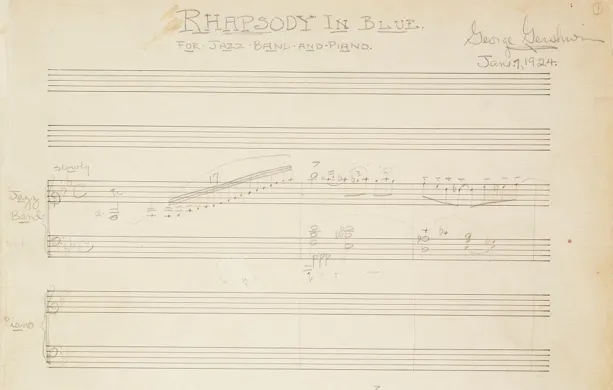
The iconic upward clarinet glissando that first rang out on 12 February 1924 in Manhattan, New York, announces the start of one of the most famous works in the history of music. Even casual music lovers know it is George Gershwin’s Rhapsody in Blue — the piece that perhaps most beautifully fused classical music and jazz. Paul Whiteman’s orchestra played, and the composer himself sat at the piano. The parts for the musicians — twenty-three of them — were prepared, however, not by Gershwin but by the now-forgotten Ferde Grofé, the arranger of Paul Whiteman’s band. The reason Gershwin did not finish the Rhapsody with his own hand was, as so often, a lack of time: only five weeks separated the acceptance of the commission from the day of the premiere. So the composer compromised, writing the work in a version for two pianos, the second of which imitated the orchestra, and he entrusted the scoring of that second piano for twenty-three instruments to Grofé, who discharged his task in a record ten days. As a footnote to this story, it is worth mentioning that this is not the best-known version of the work — today the reigning version is the one for piano and large symphony orchestra, also created by Ferde Grofé, in 1942. They say success has many fathers, but as we can see, not everyone is lucky enough to leave a lasting mark on history. Should Ferde Grofé, then, be considered the true author of Rhapsody in Blue? Or at least be remembered as a co-author — or a subcontractor — thanks to whom the work took on its final shape?
The line between an original and an arrangement is not always simple or obvious.
Beginning with this example is, of course, a provocation, for not every work has so tangled a history. But it is a deliberate provocation, and its aim was to draw attention to a problem: the identity of a musical work. For centuries that identity was so fluid that the problem of arrangement effectively did not exist. One could drop a voice, or add an accompanying melody, and the performing forces were to be chosen to suit the occasion. In the thirteenth century the same settings of chorale melodies appear in different manuscripts that differ from one another, and it is hard to say which is the prototype and which the arrangement. Anonymous arrangers shortened and lengthened their settings, added voices or removed them, and even inserted text in places that originally had none — all, of course, with their own institution’s performance practice in mind. As early as the Baroque one could make an arrangement and sign it with one’s own name, which, before the birth of copyright, outraged no one. In Romanticism, the age of geniuses, the name of the composer — and of the arranger — became more important than ever. For this reason arrangement became a way of displaying one’s own personality and creative invention, as the bravura piano adaptations of Franz Liszt testify better than anything. In the popular music of the twentieth century, arrangement became a necessity, for melody and lyrics alone are not enough to release an album of one’s own.
Gershwin’s case is therefore not an isolated one. Going to see the masterpiece of Polish opera, Halka, we usually do not realise that we are hearing later arrangements (by Kazimierz Sikorski or Grzegorz Fitelberg), because Moniuszko’s original score has not survived. An example of an adaptation (a fairly faithful arrangement) that visits many Polish homes every other week is, by contrast, the Champions League anthem — a reworking of the Baroque coronation anthem Zadok the Priest. Turning a text drawn from the First Book of Kings into a hymn to sporting rivalry shows that arrangement can serve to modernise old material and to lend it new meanings — including extra-musical ones.
That arrangement matters is best attested by the sheer number of names under which it has been concealed throughout the history of music: transcription, adaptation, setting, instrumentation, orchestration, reminiscence, paraphrase. The Wrocław musicologist Maciej Gołąb, for his part, distinguishes five kinds of arrangement (which he calls transcription): substantial, structural, syntactic, recontextual and functional. The point is not to sort things into categories and draw precise boundaries, but to indicate the various meanings, aims and means that surround this concept. So what does arrangement give us?
Arrangement, in essence, serves to bring out the features of a given musical work. A feature of many masterpieces of serious music is a complexity of texture whereby a work for a single instrument contains elements suggesting a larger ensemble. Analysing some of Franz Schubert’s piano Impromptus, we see, besides the melody, a bass accompaniment in the low register, a subtle second plane realised in semiquavers in the right hand, and a harmonic filling placed in the upper voice of the left hand. These planes may be merely hinted at (the pianist has, after all, only so many fingers), but in the arranger’s imagination they can be extended into places where they originally are not. Thanks to this, the works mentioned can be transferred quite successfully to, say, a string quartet, or even a symphony orchestra. The need for such work may be practical: a chamber ensemble (a string quartet, say) wants to add those Impromptus to its repertoire and therefore needs a setting made especially for that lineup. Arrangement is also useful for instrument teachers: instead of études, pupils often prefer to play popular tunes known from radio and television, originally scored for symphony orchestra. Then making an arrangement becomes the teacher’s duty — one they may take on or not. Producing settings is also everyday work for chamber ensembles of non-standard makeup, for which no suitable repertoire exists. Commissioning works from composers is of course laborious and time-consuming, and the resulting pieces are often written in a difficult musical language, so they are not fit for every occasion. In that case it is worth considering adapting selected classical compositions for a new lineup — which, moreover, is not always a difficult thing. Transferring a work written for clarinet and piano to a flute-and-accordion duo essentially requires only fitting the clarinet part to the flute’s range and changing the note durations in the piano part once it is transferred to the accordion (on the piano, notes can be sustained with the pedal). This, however, is only the arranging minimum, for the possibilities for creative settings are far greater.
Arrangement, then, goes by many names — under that blandly sounding term one can gather a wealth of often far-from-banal ideas that a skilled arranger may hit upon. Out of artistic need, out of necessity, for money, works arise that are something more than a mere reworking — just as, in the case of Rhapsody in Blue, they can become a meeting place for artistic individualities, one that ensures the line between original and arrangement will no longer be either simple or obvious.